Architecture of
Ocean Independence
The concept proposes a permanent habitable city in the ocean, designed as a unified autotrophic ecosystem.
Submerged Mass
"Iceberg" geometry to dampen roll and pitch. Eliminates resonance with ocean waves.
Self-Repair
Foam glass, magnesia geopolymers (MgO), and basalt – built and maintained using seabed materials.
Blue Biota
Food and water purification loops driven by aquaculture, algae, and bivalves.
Hybrid Energy
Ocean Thermal Energy Conversion (OTEC) coupled with Concentrated Solar Power (CSP) and hydrogen storage.
1. Base Positioning Criteria
For a static drifting city, the "comfort zone" dictated by water temperature, cyclone risks, and the absence of ice loads is critical.
Solution: The "Gold Belt" (Latitude 15–25°)
- Warm water year-round (+22…+28°C) enables efficient baseload energy from OTEC, which requires a ~20°C differential between the surface and deep water.
- Total absence of ice loads, which are the primary destroyers of massive floating structures.
- Positioning outside the main tropical cyclone corridors (unlike equatorial latitudes 0–10°).
2. Architectural Solutions: Iceberg & Modularity
A ship rocks because its mass and center of gravity are aligned to easily resonate with wave periods. The "Iceberg" strategy moves the system out of the resonance zone: the structure's natural dynamic period (30–60 s) drastically differs from dominant ocean waves (8–15 s).
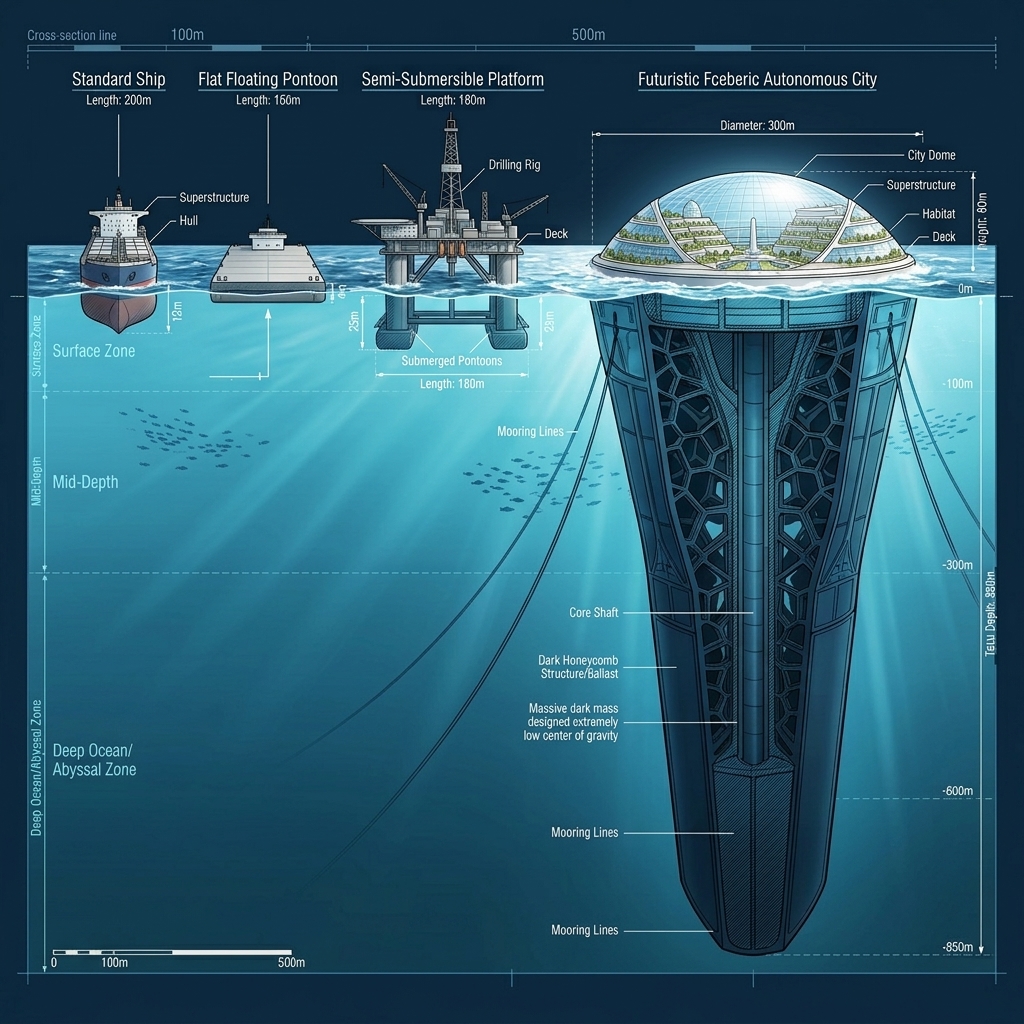
Modular Cluster
Instead of a single giant pontoon, a cluster of independent modules (7–19 units) is chosen. Modules are assembled into a hexagonal structure, where the central one acts as the administrative hub, and the periphery hosts housing and industry. This allows isolating damages and repairing sections without shutting down the city.
Typical Module Specs (Estimate):
3. Infrastructure and Psychology
Distribution of functions across vertical levels to prevent sensory deprivation:
- Underwater Zone (Depths) Sleeping quarters, data centers, offices, industrial reactors. Characterized by absolute thermal and acoustic stability. The mass of water serves as a natural radiation shield (if a backup micro-nuclear reactor is used).
- Waterline Level (Transit) Airlocks, docks, workshops. A zone of noise and high mechanical stress.
- Above-Water Towers (Light) Public spaces, light wells, restaurants, and parks. Living architecture built from composites and recycled bamboo.
4. Hybrid Energy
Autonomy requires breaking free from mainland hydrocarbon supply chains. The architecture is powered by a hybrid of renewable ocean resources:
OTEC (Baseload)
Ocean Thermal Energy Conversion uses the temperature difference between warm surface water (~28°C) and cold deep water (~4°C) to vaporize a working fluid (e.g., ammonia) in a closed loop. Provides 24/7 baseload generation (~10 MW/module).
CSP & Solar (Peak)
Concentrated Solar Power (CSP) with Fresnel lenses is needed not just for electricity, but for direct thermal heating of industrial furnaces (melting glass, metals). Hydrogen acts as an accumulator to smooth out supply dips.
5. Marine Materials Science
Traditional naval steel is unsuitable for permanent drifting — corrosion and reliance on inland dry docks destroy the autonomy paradigm. The city must grow and be repaired with what is right below its keel.
- MgO Geopolymers: Magnesia-based binder obtained by extracting magnesium salts from seawater. Allows casting concrete elements without extreme firing kilns. Chemically passive in saltwater.
- Foam Glass: The primary aggregate for buoyancy and ballast. Manufactured from silica-rich seabed sand. Highly crush-resistant and doesn't degrade over centuries.
- Basalt Fibers: The replacement for steel rebar. Pulled from volcanic seabed rock via high-temperature solar furnaces (CSP).
- Biomineral Self-Healing: Some damages are not welded, but grown. Passing low electrical currents through a steel or carbon mesh in seawater triggers the precipitation of brucite and aragonite onto the hull. Armor damage heals with natural limestone over months.
6. Food System (Blue Biota)
Hydroponics serve as a pleasant psychological addition, but baseload caloric sustenance is provided by multi-trophic aquaculture.
- Waste to Biogas: City organic waste goes into anaerobic digesters to produce energy and reclaim nutrients.
- Kelp Forests: Macro/micro algae absorb nitrogen and phosphorus, acting as a giant biofilter preventing ocean eutrophication.
- Bivalves: Mussels and oysters perform fine water filtration, maintaining coastal sanitation.
- Fish Pens: Pelagic fish complete the chain, converting algae and zooplankton into premium dietary protein.
Shell waste is processed into chitosan (bioplastics), while excess algae turns into biofuel and agar.
7. Resource Independence
The city is designed to avoid complex electronics wherever physically possible, replacing them with massive analog or mechanical architecture. However, a minimum pool of semiconductors and wiring still requires metals (Copper, Zinc, Gold, REEs).
The project includes a conditional option for Containerized bio-metallurgy of deep-sea smoker sulfides:
- Robotic collection of collapsed sulfide ores from "black smokers" (hydrothermal vents) using ROVs.
- Low-temperature bioleaching via bacteria (Acidithiobacillus ferrooxidans) in onboard reactors (30-50°C).
- Electrochemical deposition of critical metals without building blast furnaces.
Legal Status: Such extraction will be coordinated with the ISA (International Seabed Authority), strictly limited to "dormant" vents to preserve the unique seabed biome.
8. Engineering Diagrams
Autonomy Material Cycle
Multi-trophic Network
Project Participation
This concept is an Open-Source draft of a global idea. Your engineering and architectural feedback determines the development trajectory.
Concept Discussion
Sign in through a convenient platform to drop comments and likes. We value mindful discussion without anonymity.
Connecting to deep-sea server…
OC_V1.0.1 // PROTOCOL INIT // SECURE CONNECTION ESTABLISHED